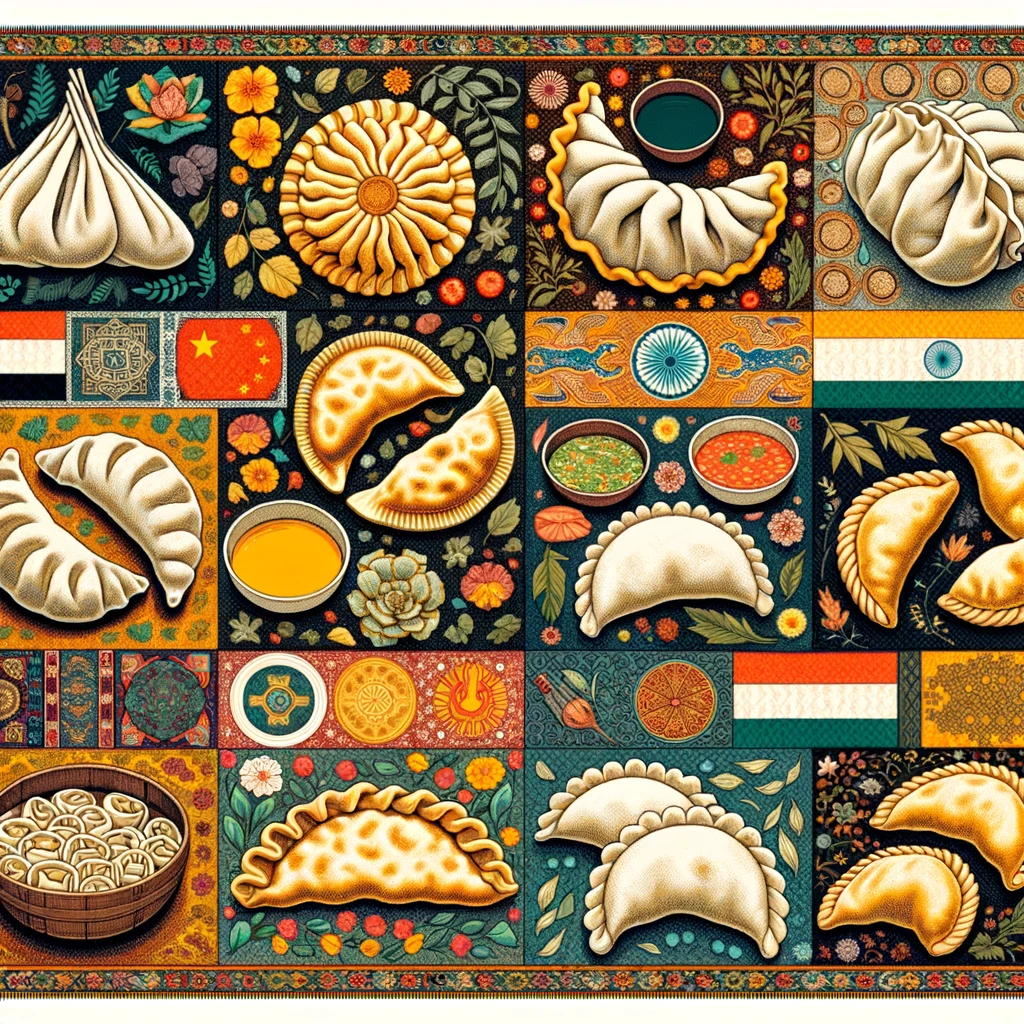
Dumplings do not have one tidy origin story. Long before modern borders, cooks in different places discovered the same useful idea: combine an inexpensive starch with a filling, or shape it into a small piece, then boil, steam, bake or fry it. Some dumpling traditions are historically connected. Others may have developed independently because the method is practical, adaptable and delicious.
That distinction matters. It is tempting to draw a single line from ancient China to every pierogi, raviolo and momo eaten today, but the evidence does not support such a simple family tree. Food historian Ken Albala has argued that dumpling-like foods may reach back into prehistory, while surviving dumplings from China's Tang dynasty show that recognizable forms were being made more than 1,000 years ago. The honest answer is therefore more interesting than a single inventor: dumplings are both local creations and records of cultural exchange.
What counts as a dumpling?
The English word covers several related foods. A dumpling can be a filled wrapper, such as a Chinese jiaozi, Polish pierogi or Georgian khinkali. It can also be an unfilled piece of dough or batter cooked in liquid, like a German Knödel, Italian gnocchi or the soft flour dumplings served with stews in Britain and North America. Some definitions stretch further to leaf-wrapped rice parcels and filled pastries.
Rather than forcing every example into one category, it helps to look at three elements:
- The wrapper or base: wheat dough, rice flour, potato, bread, cornmeal or another starch.
- The filling: meat, seafood, vegetables, cheese, fruit, beans—or no filling at all.
- The cooking method: boiling, steaming, simmering, pan-frying, deep-frying or baking.
Those choices reflect local grain crops, climate, religion, preservation methods and household economies. Dumplings are global, but they are never placeless.
How old are dumplings?
No one can identify the world's first dumpling. Soft dough rarely survives in the archaeological record, and early written recipes do not always match our modern categories. What historians can document is that dumpling-like foods are ancient and appeared in more than one region.
In China, wheat milling expanded during the Han dynasty (206 BCE–220 CE), after contact with lands to the west. Han cooks developed a broad family of wheat-based “noodle foods,” including dumplings and steamed breads. By the Tang dynasty (618–907 CE), people in northwestern China were making filled dumplings that would look familiar on a table today.
China also has old rice-based traditions. Zongzi—glutinous rice parcels wrapped in leaves—were eaten as seasonal food in forms documented as far back as the Spring and Autumn period (roughly 770–476 BCE). They differ from wheat-wrapper dumplings, but show how broadly the parcel principle developed.
Europe has its own long history of boiled and filled doughs. Medieval and Renaissance manuscripts record dishes related to ravioli, gnocchi and bread dumplings. These foods were shaped by local ingredients and by centuries of contact around the Mediterranean and across Eurasia.
How dumplings traveled across Eurasia
The Silk Roads were not a single highway carrying one recipe westward. They were overlapping land and sea networks where traders, soldiers, pilgrims and migrants exchanged ingredients, techniques and words. A dish might move only part of the route, change in a trading city, and travel onward in a new form.
The manti family makes that process visible. Related names and preparations appear across Central Asia, Turkey, Armenia, Iran, Korea and the Himalayan region: manti, mantı, mandu and momo. The wrappers, fillings, shapes and sauces vary dramatically. Smithsonian research notes that the exact starting point remains uncertain; what is clear is that the dishes and their names reflect old connections between distant cultures.
Nepal's momo offers a more specific example of adaptation. Its precise origin is debated, but it is widely associated with trade between Newar merchants of the Kathmandu Valley and Tibet. In Nepal, cooks developed versions seasoned with local spices and served with a lively tomato-based achaar. A borrowed form became unmistakably local.
Migration continues the process today. Chinese, Polish, Ukrainian, Korean, Tibetan and many other communities have carried dumplings into new cities, where they preserve family memory while absorbing new ingredients. Frozen production, restaurants and social media now move styles faster than the old caravan routes ever could.
Dumplings around the world
| Tradition | Typical form | Common cooking method |
|---|---|---|
| Jiaozi (China) | Wheat wrapper with meat or vegetable filling | Boiled, steamed or pan-fried |
| Mandu (Korea) | Filled wheat wrapper in many regional shapes | Steamed, boiled, fried or served in soup |
| Momo (Tibet, Nepal and the Himalayas) | Thin wrapper, often filled with meat or vegetables | Usually steamed; also fried |
| Manti / mantı (Central and Western Asia) | Filled pasta ranging from large parcels to tiny folded pieces | Steamed, boiled, baked or cooked in broth |
| Khinkali (Georgia) | Pleated pouch with a seasoned, juicy filling | Boiled |
| Pierogi / varenyky (Central and Eastern Europe) | Half-moon wrapper with potato, cheese, cabbage, meat or fruit | Boiled, sometimes fried afterward |
| Ravioli and tortellini (Italy) | Egg-pasta parcels with cheese, meat or vegetables | Boiled and served with sauce or broth |
| Knödel (Central Europe) | Unfilled or filled balls based on bread, potato or flour | Boiled or gently simmered |
| Gyoza (Japan) | Thin wrapper with finely chopped filling | Commonly pan-steamed for a crisp base |
This table is a map of differences, not a claim that every item descends from the same ancestor. Even within one name, recipes shift from region to region and household to household.
Why dumplings became celebration food
Dumplings turn modest ingredients into food suited to a gathering. Making them is repetitive work, so several hands around a table can transform preparation into a social ritual. One person rolls, another fills, another pinches. Skill passes through observation rather than a written recipe.
That communal pattern appears in many cultures. Families fold jiaozi for Lunar New Year; momo-making brings households together across Himalayan communities; pierogi are prepared for holidays and family meals in Poland and the diaspora. Their meanings are not interchangeable, but the shared labor helps explain why dumplings so often carry ideas of reunion, hospitality and continuity.
Shape can carry symbolism too. In parts of China, jiaozi are associated with prosperity because their form recalls historical silver ingots. Round tang yuan evoke togetherness through a visual play on family reunion. Elsewhere, the importance lies less in shape than in a filling or technique associated with a particular holiday.
The practical intelligence inside a dumpling
Every dumpling balances the same technical problems. The wrapper must be strong enough to contain moisture but tender enough to eat. The filling must cook in the time the dough takes to finish. Seams need to stay closed as steam expands and juices collect.
That is why regional techniques matter. A boiled dumpling generally needs a wrapper and seal that tolerate movement in water. A steamed dumpling can use more delicate pleats. A pan-steamed dumpling is engineered for two textures: a crisp base and a supple top. Soup dumplings require chilled, gelled broth that melts only after the wrapper has set.
The best way to understand these foods is therefore not to ask which nation “owns” the dumpling. Ask what local cooks needed the dough to do, which ingredients they had, and with whom they shared the table.
So where did dumplings originate?
Dumplings originated in more than one place. Ancient China provides some of the earliest surviving physical and written evidence for recognizable filled dumplings, while other regions developed their own boiled, wrapped and filled dough traditions. Later trade and migration connected some of these foods, especially across Eurasia, without turning them into a single uniform lineage.
That mixed history is precisely why dumplings are so revealing. A wrapper can preserve a local tradition, record a migration route and adapt to a new home—all in one bite.
Related reading: Follow another staple across borders in the global history of noodles, or explore how soups and broths bring food traditions together.